
 FiSw026

|
Attack from the South Fire and Sword #27 |
||
|---|---|---|
| (Defender) Germany | vs | Soviet Union (Attacker) |
| Formations Involved | ||
|---|---|---|
| Germany |  |
1st Panzer Division |
| Germany |  |
23rd Panzer Division |
| Soviet Union |  |
84th Rifle Division |

|


| Overall Rating, 3 votes |
|---|
|
3
|
| Scenario Rank: --- of 1094 |
| Parent Game | Fire and Sword |
|---|---|
| Historicity | Historical |
| Date | 1944-12-20 |
| Start Time | 11:30 |
| Turn Count | 15 |
| Visibility | Day |
| Counters | 70 |
| Net Morale | 1 |
| Net Initiative | 2 |
| Maps | 2: 50, 54 |
| Layout Dimensions | 56 x 43 cm 22 x 17 in |
| Play Bounty | 169 |
| AAR Bounty | 163 |
| Total Plays | 2 |
| Total AARs | 2 |
| Battle Types |
|---|
| Exit the Battle Area |
| Inflict Enemy Casualties |
| Road Control |
| Conditions |
|---|
| Entrenchments |
| Minefields |
| Off-board Artillery |
| Randomly-drawn Aircraft |
| Scenario Requirements & Playability | |
|---|---|
| Fire and Sword | Base Game |
| Introduction |
|---|
|
The renewed Soviet offensive opened with an early morning artillery barrage that fell on a broad line from Tác to Lake Velence. Soon after, vastly superior infantry formations supported by a few tanks and fighter aircraft moved out. In the central sector, south of Székesfehérvár, most of the newly-deployed Hungarian troops abandoned their positions. The Soviets immediately exploited those openings to bypass the German-held sectors instead of attacking the strongpoints frontally. Men from the Soviet 84th Rifle Division, having just been released from the 135th Rifle Corps reserve, infiltrated through the puszta from Bodakoyator to Pötöle. |
| Conclusion |
|---|
|
The precipitate Hungarian withdrawal carried some German panzer grenadiers, anti-aircraft gunners and especially the raw recruits of the 153rd Field Replacement Division with it. At 1130, 1st Panzer Division placed its Panzer Group Hagen under command of the 23rd Panzer Division, and its fourteen Panthers eliminated a number of penetrations in the vicinity of the Börgönd airfield. At 1400, the Germans evacuated the Fövenypuszta hamlet and the panzer grenadiers pulled back behind the railroad. According to the 3rd Ukrainian Front’s daily report, ISU-152 and ISU-122 heavy assault guns provided support for the rifle troops until 1500. Although the German and Hungarian artillery provided excellent support for the defenders and often continued direct fire until the very last moment, most of the positions were lost to the attackers. The German and some Hungarian strongpoints defended themselves stubbornly, all the while subjected to rolling fight-bomber attacks. The former main line of resistance held on for several hours. The Soviets crossed the railroad behind the panzer grenadiers and at 1800 reached Hill 129, just six kilometers south of Székesfehérvár. In the evening, the Axis troops began to build a new defensive line five kilometers south and southwest of Székesfehérvár. |

|
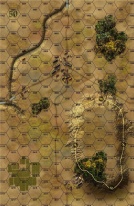
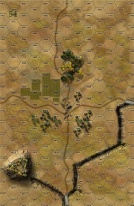
|
|---|
| AFV Rules Pertaining to this Scenario's Order of Battle |
|---|
|
| Heer |
|---|
|


| Army (RKKA) |
|---|
|


| Guards |
|---|
|


| 5 Errata Items | |
|---|---|
| Scen 27 |
Scenario special rule nr 4 (Mire) should be changed : "Add one to the Mire die roll result" (leonard
on 2025 May 07)
|

|
Two 105mms (ID#s 1204, 1205) have "16-31" fire values in black (direct fire), when they should be in white (indirect fire). (Shad
on 2010 Dec 15)
|

|
The reduced direct fire value of the Heer HMG became 5-5 starting with Fall of France. (plloyd1010
on 2015 Jul 31)
|

|
All SPW 251s have an armor value of 0. (Shad
on 2010 Dec 15)
|

|
The reduced direct fire value in Kursk: Burning Tigers is 4-4. (plloyd1010
on 2015 Jul 31)
|
| Fire & Sword, scenario #27: Attack from the South. | ||||||||||||
|---|---|---|---|---|---|---|---|---|---|---|---|---|
Fire & Sword, scenario #27: Attack from the South. First let me state, the Mire special rule killed this scenario for me, as the attacker will have little chance for success especially if the other side have minefields. So I will not play scenarios 24-29 with the Mire rule. I played this scenario and forgot the Mire rule on page 38 is optional and played with it this time before I realized it was optional. It just takes too long, 4 turns to get a vehicle un-mired, just to get stuck again on the next movement hex. No fun at all! The Soviets have three victory objectives in this scenario and depending on how many they achieve or don’t achieve determines the victory level for each side. The German Force is about half the size of the Soviet force but have entrenchments, minefields a JgPzIV/70 unit and Panther tank reinforcements on turn two. The Soviets have twice the Infantry force and ISU-152 & ISU-122 Guard units and a dice roll for air-support each turn, both sides have off map artillery support. Because I used the Mire rule in this scenario, my Soviet armor had to go down the road until it hit mines and had to exit into the clear mire hexes where most got stuck and picked off. The Soviets Infantry made it to the main line of German defenses where they were blunted. On their right flank, they were barely able to exit 10 steps of Infantry steps off the north edge of the map, avoiding a German Major victory but giving the Germans a Minor Victory as the Soviets lost three times as many steps and did not control all of the east-west railroad. I think if I had ditched the Mire rule, this would have been a closer match and certainly more fun scenario. I’ll be interesting to see other players take on the Mire Rule. |
||||||||||||
| 1 Comment |
| Attack in the Puszta | ||||||||||||||
|---|---|---|---|---|---|---|---|---|---|---|---|---|---|---|
The German defence was of course concentrated around the hamlet in the centre of map 54. To the extreme east of the railway line, a 105mm artillery gun threatened the right flank of the Russian attack. The western part of the railway line would be defended by one of the Panthers, which would take up position on the small hill to the rear. Mines protected the hamlet and the bridge where the two maps separated. As we played, we corrected the error in the mud rule. Mechanised vehicles are only immobilised on a die = 1. Even so, the Soviet player attacking to the west had a lot of immobilised vehicles in bad shape. The JpzIV/70 was happy to turn them into scrap heaps. As Russian losses mounted, the 1st victory condition quickly became unattainable. As the third victory condition (control of the entire railway line) was itself extraordinarily difficult for the Soviet player, the deal was done and German victory assured. This scenario is undoubtedly too favourable to the German player (60-40 pro-German). |
||||||||||||||
| 0 Comments |
There's an error in special rule nr 4. It should be changed to : "Add one to the Mire die roll result". This rule should be changed accordingly in every Fire & Sword scenario where it appears.