
 ElsR011

|
Twin Villages: Finale Elsenborn Ridge #12 |
||
|---|---|---|
| (Attacker) Germany | vs | United States (Defender) |
| Formations Involved | ||
|---|---|---|
| Germany |  |
12th Infantry Division |
| Germany |  |
12th SS “Hitler Jugend” Panzer Division |
| United States |  |
2nd "Indianhead" Infantry Division |
| United States |  |
644th Tank Destroyer Battalion |
| United States |  |
741st Tank Battalion |

|


| Overall Rating, 15 votes |
|---|
|
4
|
| Scenario Rank: 104 of 1094 |
| Parent Game | Elsenborn Ridge |
|---|---|
| Historicity | Historical |
| Date | 1944-12-19 |
| Start Time | 06:30 |
| Turn Count | 16 |
| Visibility | Day |
| Counters | 56 |
| Net Morale | 0 |
| Net Initiative | 0 |
| Maps | 1: 23 |
| Layout Dimensions | 43 x 28 cm 17 x 11 in |
| Play Bounty | 67 |
| AAR Bounty | 124 |
| Total Plays | 14 |
| Total AARs | 9 |
| Duplicates | EbRR009 |
| Battle Types |
|---|
| Urban Assault |
| Conditions |
|---|
| Off-board Artillery |
| Scenario Requirements & Playability | |
|---|---|
| Elsenborn Ridge | Base Game |
| Introduction |
|---|
|
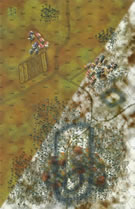
During the night of the 18th, the American command decided its troops had held the twin villages for as long as necessary to disrupt the German timetable. The defenders could pull out the next night. Meanwhile, the German command had decided that the Hitler Youth had had enough; the SS division would assault the twin village for one more day and then give way to an Army panzer grenadier division form the Army Group reserve. Kraas was determined to redeem his command with success, whatever the cost to his young fanatics. |
| Conclusion |
|---|
|
Both sides remained relatively quiet during the night, but when daylight came fighting again erupted in both villages. Massive American artillery barrages again claimed many German infantrymen's lives, and in the early afternoon 2nd Infantry Division ordered its troops to pull out as soon as darkness fell. Fighting died down as the Americans prepared to leave, and rather than press their advantage the battered Hitler Youth and Volksgrenadiers gladly let them go. |

|
|
|---|
| AFV Rules Pertaining to this Scenario's Order of Battle |
|---|
|
| Heer |
|---|
|


| Schutzstaffel |
|---|
|


| Army |
|---|
|


| 5 Errata Items | |
|---|---|

|
The reduced direct fire value of the Heer HMG became 5-5 starting with Fall of France. (plloyd1010
on 2015 Jul 31)
|

|
The reduced direct fire value of the SS HMG is 5-5 in Beyond Normandy and Road to Berlin. (plloyd1010
on 2015 Jul 31)
|

|
The Units in Beyond Normandy were misprinted with a movement factor of 5. The movement factor should be 8. (rerathbun
on 2012 Mar 21)
|
|
|
Liberation 1944's counters are mislabeled 'PzIVF2.' The counter's ratings are correct (Armor 5, Move 8, DF 11-6, AT 6-8). (rerathbun
on 2014 Feb 14)
|

|
The M18 has a special rule in Battle of the Bulge but it applies globally: "A two-step M18 unit can fire one anti-tank shot and move half its movement allowance (retain fractions) in a single impulse. The order in which it does these two actions is the player's choice." (Shad
on 2010 Dec 15)
|
| Es hat Hölle Geregnet | ||||||||||||
|---|---|---|---|---|---|---|---|---|---|---|---|---|
After an uneasy night, all hell broke lose when German Hitler Jugend troops found themselves in assault range of the American 99th Infantry Division. With dawn breaking, the Germans immediately neutralized all American vehicles. However, while this was happening, the Americans made a strong bid for the Northern town. Defending SS troops suffered great losses and building by building, they lost control of the northern town. Two platoons of Panthers that came to the rescue of the Hitler Jugend couldn’t even slow the Americans down and were demolished within minutes. Meanwhile, threatening units of the 12th Volksgrenadier took up positions on the eastern wooded hills but they were wiped out when a tremendous artillery barrage kept pounding them for more than an hour. Not one German unit or leader survived this rain of hell. At 9.30, firing ceased and a stand-off ensued. The Americans had a tight hold on the northern village, whilst a few rugged SS and 2 platoons of PzIV held the southern town. Both sides had not the means nor the intentions of attacking the other because of the other side’s artillery threat. And so VP were counted and the Americans took it 45-39. All could have been very different were it not for the murderous american artillery support. Or as my opponent pointed out after the battle : «Es hat Hölle geregnet ! » |
||||||||||||
| 0 Comments |
| Even The Tanks Are Bleeding | ||||||||||||
|---|---|---|---|---|---|---|---|---|---|---|---|---|
Wanting to play a Bulge game on this anniversary of the Bulge, and wanting to play something fitting to the date, I selected this scenario. The set-up includes both sides placing a total of 10 wreck counters in the two towns, and then the I-go-u-go thing as each side places a unit and then a leader until they are all placed. Germans won the initiative and pretty much kept it as far as I could manage to play, and it was sort of sad what Panthers and Mk IVs could do to tanks in adjacent hexes, as right from the start, they took out all 3 Shermans and both M-18s in turn 1 and lost a step of Panthers to a bazooka in turn 2. Otherwise, the US losses at the start of turn 6 was 30 to only 5 for the Germans, with US units stuck in assaults, cut off and surrounded so that any fleeing troops would be an immediate loss. With only a handful of US units left, their Colonel passed the word to only surrender to the German regulars, avoid the SS if possible, and with that, the twin villages fell into German hands. |
||||||||||||
| 0 Comments |
| Rotunda victoria alemana |
|---|
|
Esta batalla comienza de una manera caótica, ya que ambos contendientes despliegan sus unidades una por una y alternativamente. Inicialmente tiene lugar una batalla de tanques en la que los "Sherman" y M18 americanos son completamente barridos por los "Panther" y PzIVH alemanes (aunque estos pierden una sección y media de de PzIVH). Los combates se centran en torno a las dos ciudades, una al norte y otra al sur. Los americanos concentran la mayoría de sus fuerzas en la ciudad del norte, más grande. En la ciudad del sur, de apenas tres hexes, los alemanes controlan dos tercios. Aquí los germanos expulsan rápidamente a los americanos y se hacen con el control total de la población. Pero la verdadera batalla tiene lugar por el dominio de la otra población. Los alemanes hacen uso de dos secciones de "Panther" para ir desgastando (andanadas en la columna 22 de la tabla de fuego directo) a los defensores protegidos en las casas. Los americanos replican con el fuego demoledor de su artillería fuera del mapa (3x24, 6x18). Poco a poco los alemanes se van haciendo con el control de la población y anuquilando a la mayor parte de los defensores. Al final los alemanes consiguen controlar cuatro hexes de las dos poblaciones y neutralizar el resto, salvo un hex controlado por los americanos. Los alemanes obtienen 49 VP y una victoria mayor. Los americanos obtienen 23 VP. |
| 0 Comments |
| Assualt can be your friend | ||||||||||||||
|---|---|---|---|---|---|---|---|---|---|---|---|---|---|---|
This scenario has each side placing wrecks then units alternating US then German. This adds to the overall time to play. We ended up setting up mostly in the town hexes. At most 25% of the units were outside the town hexes. All of the tanks are in clear terrain. I won the the initiative with two activation s. Read the game rules. All inf type units have the special anti-tank capability. The US army Hellcats setup hidden. Did not read that. Would it have helped? Who knows. I forgot about the German Army having only a 7/6 moral while the US Waffen is 8/7. Bruce kept the Germans separated into German and Waffen stacks. The first turn I had my tanks use AFV fire at 0 modifier. In return the Mk IV's and Panthers were +3 or more. The tanks were stacked w/inf so they could go into the assault and add a column shift. After the Germans destroyed my tanks assault was easier for them because of the column shifts. We slowly eliminated our infantry and one of the German tanks. It settles down into artillery duel. Bruce ended up +9 for a minor victory. Again remember the hidden M-18 and special anti-tank inf fire in assault. I think the US should use assault early in the game before his tanks are destroyed. Otherwise there are going to be stacks of 3 in the various town hexes. |
||||||||||||||
| 0 Comments |
| CARNAGE IN A WINTER WONDERLAND |
|---|
|
With Bulge season upon us, and having recently acquired the Winter maps for Elsenborn Ridge, it was time to break them in. First up was Twin Villages: Finale The opening "alternating" setup ended with the Americans holding three hexes of the large town (opposed by Army units in the other two) and one of the smaller town (opposed by SS units,) Allied M4's were split among the town hexes while the Germans started their panzers outside, to move where needed, and also to confront the roaming M18s (which both set up under cover of light woods,) The balance of German forces set up in the cover of woods near the towns, while one American INF and a leader set up on the hill to act as a reserve and spot for artillery. Early on, the Hellcats played "shoot and scoot," managing to take out a step of Panthers. While the rest of the Panthers did what they could to stalk the M18's (after disposing of the M4 unit in the three-hex town), eventually taking them out with no further loss, the PZ-IV's helped the SS clear the three-hex town, then moved up to the 5-hex town to aid the faltering German army units, which were shoved out amidst multiple morale failures - then suffered worse from the "wrath of God" US artillery after being ejected. One step of PZ-IV fell victim to Shermans in the northern town but, after removing the M18 threat, the Panthers erased the rest of the US M4's. This complicated the town assault, as several hexes of the five-hex town accumulated three wrecks, denying the German tanks entry. By the end of Turn 6 the US had no vehicles left - but then the artillery took charge. SS attempts to move infantry to the northern town were fractured by the American guns, as was the Army contingent trying to recover and get back in the fight. With no infantry readily available the PZ-IV's entered a town hex alone, but were sent packing with the loss of another step in the assault combat (one half-strength PZ-IV was demoralized, fled to a light woods haven, and spent almost the entire rest of the scenario recovering.) As the Panthers blasted away at town hexes from point-blank range, accomplishing a little but not much, SS infantry occasionally made it to the town (and even briefly in the town) but was eliminated or sent packing. The town combats were not without loss for the Amis, and one platoon that fled into the open was destroyed by German artillery, but in the end - as the scenario "conclusion" notes - the Germans were doubtlessly relieved to see the Americans pull out. At game's end, the Germans had three town hexes, the US four, with one in dispute (a reduced SS PZ-IV plus a reduced Army HMG and one leader.) So that was a 12-8 VP lead - but losses negated that. German losses were staggering - only 3 tank steps (2 PZ-IV, one Panther) but a whopping 15 Army GREN, 1 Army HMG, one SS HMG and 8 SS GREN. The Americans lost all 10 AFV steps, plus 7 INF and 3 HMG. (The Germans also lost 6 (!) leaders - 3 SS, 3 Army - to the USs 1, but no VP for any of those.) When the smoke cleared, it was a draw at 34 VP apiece. |
| 0 Comments |
| A Tale of Two Cities | ||||||||||||||
|---|---|---|---|---|---|---|---|---|---|---|---|---|---|---|
It was the best of times. It was the [goddammit]! Treadasaurus's excellent AAR will suffice for the blow-by-blow account of this scenario. So the best things first.... As the Germans, I called the Lederhosen League, the intercolated setup of forces was very useful and pushed the Germans out of their safety zone, some (like my more experienced opponent) might think of this style setup with wrecks and alternating unit setups as gamey and unrealistic. However, I believe this helped get us into the action faster and with several tactical advantages as being able to start assaults on the first turn in the northern and southern towns added to the variety of early situations that we were able to play from almost the first turn. Personally, I also like meeting engagement-styled battles and this, initially, felt like it fit the bill for that. Now, for the painful.... Assault rules are VERY gamey and unintuitive, so if you are in a position to conduct a close assault or extended assault in the town, it will be a multi-turn (or whole game) slog, preventing and pinning these units any useful maneuver, spotting, oppty fires, arty strikes, etc. With victory being relegated to unit losses, the German survival of the towns pretty much went the way of the dominant assault hex; a zero-sum game of win or lose, with no in-between. What the Germans lost by underdeploying in the northern town simply extended the loss to the southern town, when trying to inflict damage on the American armor. There was no significant damage to the US infantry past the initial 2-3 turns as they dug in and occupied the northern town in which they dominated. Artillery is VASTLY unbalanced against the Germans, even removing the American 82mm mortar on Turn 1, the single German 81mm mortar has almost a comically bad firepower. Same with the four batteries of off-map, useable but just barely, given the heavy woods, towns, and severe leader spotting requirements, some of which had to do with that initial depolyment, above. Biggest German error was to deploy in force to the eastern wooded hills that, while protecting that precious mortar platoon, pinned these units making them unavailable for any maneuver action to the west. Rather annoyingly, the US M18 tanks with their 14 MP move/fire capability and reasonably thin armor made them easy rather armor targets but almost impervious to infantry and artillery, giving them a "rock-paper-scissors" effect where the M18 guns provided assault capability and far range, but weak to Panzers. Panzers though were unaffected by the M18 guns (or just about anything else) were up against the rules limitations often pinning them in place. German infantry units, as they were deployed, were generally never useful to the Panzers. So maybe, in a roundabout way, these were the most realistic elements of this scenario. In all, I enjoyed the gameplay with my opponent, but would have deployed to the southern town and held court there as a single base of German operations, instyead of splitting forces in the wooded hills and both towns. |
||||||||||||||
| 0 Comments |

| Hold the Villages & Attrit the Charging Germans | ||||||||||||||
|---|---|---|---|---|---|---|---|---|---|---|---|---|---|---|
This was a fun-filled, but VERY gamey, 5-session play through with the intrepid yet careful, Isra3lite leading attacking elements of the German 12th SS Panzer & 12th Volksgrenadier Divisions in a 16-turn battle. I had a mixed bag of slightly reinforced, defending elements of the American 99th and 2nd Infantry Divisions, with an initial visibility level of 4 hexes. Better than average leaders were drawn by each side. Both sides also setup aggressively in and around the two villages. We used FOW, smoke/illum, excess initiative, tank riders, strategic movement and extended assault optional rules, as well as these two house rules: 1) Road Movement for Mechanized & Foot Units - All FOOT & MECHANIZED units may move on roads at the rate of 1/2 of a Movement Point (MP) per road hex, just like MOTORIZED units, and 2) Standardized Movement for Mechanized Units — All mechanized units may move through clear hexes at a movement cost of only 1 movement point (MP) per hex, instead of 1 1/2. Add one to this cost if moving up, across, or down slopes hexes. Our hard-fought, first session (game turn 1) featured multiple, adjacent-hex firefights. Fierce fighting was initiated by the Germans against the two GI garrisons in each village. The Germans began in only 1 of 6 hexes in the northern village but occupied 3 of the 4 urban hexes in the southern counterpart. Step losses were 2 for the GIs and a single step for the German side by the end of this session. The action-packed, second session (game turns 2-3) featured some exceptional combat die rolling luck for both sides. The updated step loss tally was now: 8 for the Germans and 7 for the American defenders. The first armor loss occurred in a close assault in the northern village, where a Nazi Pz-IVH platoon was halved, increasing the existing wreck marker by another point. Heavy casualties on the eastern hill mass saw both sides dropping a level of initiative this session. Our early morning, third session (game turns 4-5) featured rapidly improving visibility and 4 additional German steps losses, plus a leader, caused a decrease in initiative level. Repeated OBA strikes by both sides had wildly variable results. Multiple SS morale recoveries, the collapse of the German offensive on the 20-meter hill, and a bold left flank armored thrust were all highlights this session. The defending GIs now led in victory points by a score of 20-15, with a pair of town hexes still hotly contested. The exciting, fourth session (game turns 6-7) featured heavy fighting that resulted in an additional 6 German step losses – plus a leader – while the embattled American side lost 4 more steps. The Third Reich’s left flank armored move was successful in reaching the vicinity of the besieged Germans in the northmost hex of the northern town and also paid a dividend with the elimination of a platoon of American M-18 Hellcats. Ferocious close assault fighting in both assault hexes was relatively productive for the GIs, particularly in the 3-hex southern town, where reinforcements arrived in the 7th game turn, liberating the northern margin of the settlement. Several OBA strikes reduced the size of the German infantry force atop the wooded hill mass, allowing a redeployment of US armor, and the temporary relief of the besieged US garrison in the 3-hex town. Our fifth session (game turns 8-9) ended when the German side conceded at the start of the ninth game turn. The GIs had just secured the last contested hex in the northern town. The final score was 31 for the American side and 11 for the Germans. An unexpected, major American victory was the result. There were 5 FOW-shortened game turns of the 9 played. This is a gamey scenario on a single map board that marginally favors the charging Germans. The more experienced player should lead the defending American side. I give this difficult-to-set-up scenario a solid 4 in SHARED online play. While fun to play with an opportunistic & challenging opponent – as published – it is probably better suited for face-to-face play, rather than online SHARED or SOLO play. It certainly highlights the criticality of proper attack sequencing, careful movement & effective placement of supporting weapons. IMHO, the victory conditions need a rewrite requiring that both towns be held by the winning side at the end of play. |
||||||||||||||
| 0 Comments |
| Slugfest in the towns | ||||||||||||
|---|---|---|---|---|---|---|---|---|---|---|---|---|
This screnario is very interesting and possibly a bit unbalanced for the Americans. The situation is the final attack on the twin villages. Germans have inflitrated the US lines and both towns are occupied by both German and American troops. An SSR allows for alternating setup of units and setup of units next to each other to simulate the German inflitration. The fight sets up to be a mixture of assualts, close direct fire as well as massive OBA raining over both sides. The victory conditions are points for town control and step losses, so its going to be a blood bath. The Americans have an edge with OBA, Germans with armor and firepower, number of troops is about the same with a slight advantage to the Germans. As for leaders the Germans received a 1-1 and a 1-2 leader with the Americans just getting a 1-1 Captain and several 1-0 lieutenants. The battle started with the American tanks getting nearly wiped out. With the Germans able to setup next to the tanks their firepower is overwhelming. So the Americans get in a big VP hole quickly. The Germans have to take the towns too, if the Americans dislodge Germans from a town it is a turnaround of 6 vp (4 for the German loss and 2 for the American gain). The Americans will be tough on the assualts with a morale of 8/7. Most of the first 2 hours of the scenario was OBA and positioning for assualts with step losses coming from OBA, assualts and direct fire from an adjacent hex. The Germans held strong until the SS in one town started to demoralize from OBA and dirct fire. Eventually, the broke and ran and slowly the Americans positioned more troops to assualt the remaining units. American bazooka teams proved themselves taking on PzIVh and Panthers to retake the town. German losses were too heavy with alot of the regular army troops breaking and running from the fight. The Americans finally won 42-35 with the capture of all but two town hexes and some heavy German losses. I rated this a 3 because the setup rule with tanks puts the American in the hole quickly and it is hard to recover. In my scenario they did but I have to use all PG tricks that I could think of to do it. I would look to play this one with some one just learning particularly with assualts and town morale bonuses. I will say I did miss one rule with wrecks, I thought wrecks applied to stacking of all units in a hex, but reading the rules they only apply stacking limitations to armor in a town or bridge hex. |
||||||||||||
| 0 Comments |
| A 72-Hour Battle Concludes | ||||||||||||
|---|---|---|---|---|---|---|---|---|---|---|---|---|
The initial setup was very similar to the third Twin Villages scenario, with wreck markers littering the two towns and the Americans and Germans attempting to outmaneuver each other when placing pieces and leaders Go-style. Unlike the previous installment, the Germans load up in the Northern town, attempting to gain a numerical advantage while the Americans spread out and defend both towns. The first half of the operation saw the Germans immediately attack in three assault hexes in the northern town. The Germans Panthers and M18s continue playing cat and mouse, using the northern village, hilltop and woods as concealment to maneuver. No losses to Armor from AT fire during the first half of the scenario. The M18s survived an unlucky loss of initiative while stuck in AT fire range of the Panthers as they rolled a 3 and a 4 to miss the M18s at range. The Americans attempt to make up for the disadvantage of Infantry units by committing their own M4s against the German assaults, but the German PzIVHs blast them away at close range, while American Infantry score two kills on the German tanks. Amongst the grind of assaults, the Americans are only able to withstand the combined arms attack for six turns before they are kicked out of the northern town. As the Americans are forced to cut and run, the American commander brings the full force of the artillery advantage to bear, disrupting the German forces to cover the American retreat south. As the second half of the game started, the Germans manage to recover and consolidate rapidly in the north. They have a significant numerical advantage at this point in Infantry units, and the Armor is still in the balance. The Germans rapidly advance from north to south, accepting losses to American artillery to force a decision in the southern town. The M18s and Panthers settle into staring at each other from limiting terrain, neither side wanting to make the first move and losing more steps. The Americans in the southern town attrite about a third of the German force, but the Germans have plenty of Infantry Platoons remaining to open assaults and open a foothold in one town hex but are rapidly running out of time. As the game concludes, the Germans hold five town hexes in the north and one in the south and have active assaults in the other two town hexes. Conclusion: German Major Victory (45 VP to 19 VP) |
||||||||||||
| 0 Comments |