
 ChIn003

|
Counterattack Chihuahua Incident #4 |
||
|---|---|---|
| (Defender) United States | vs | Mexico (Attacker) |
| Formations Involved |
|---|

|


| Overall Rating, 3 votes |
|---|
|
3
|
| Scenario Rank: --- of 1093 |
| Parent Game | Chihuahua Incident |
|---|---|
| Historicity | Alt-History |
| Date | 1916-06-01 |
| Start Time | 08:00 |
| Turn Count | 16 |
| Visibility | Day |
| Counters | 53 |
| Net Morale | 1 |
| Net Initiative | 0 |
| Maps | 1: 19 |
| Layout Dimensions | 43 x 28 cm 17 x 11 in |
| Play Bounty | 157 |
| AAR Bounty | 163 |
| Total Plays | 2 |
| Total AARs | 2 |
| Battle Types |
|---|
| Delaying Action |
| Exit the Battle Area |
| Inflict Enemy Casualties |
| Urban Assault |
| Conditions |
|---|
| Off-board Artillery |
| Scenario Requirements & Playability | |
|---|---|
| Chihuahua Incident | Base Game |
| Road to Berlin | Maps |
| Introduction |
|---|
|
As the Americans pressed deeper into Chihuahua, Mexican President Venustiano Carranza ordered them to withdraw. Only movement back toward the United States would be tolerated. Carranza wanted his army to attack the invaders if they did not pull back, but the Mexican generals believed — correctly, as it turned out — that the Americans would soon have to return to the United States as desertion, lack of supplies and alcohol abuse all took their toll. |
| Conclusion |
|---|
|
None. |
| Additional Notes |
|---|
|
There are Mexican cavalry leaders in this scenario, determined by the Mexican player. |

|
|
|---|
| Army |
|---|
|


| Army |
|---|
|


| Counterattack fails | ||||||||||||
|---|---|---|---|---|---|---|---|---|---|---|---|---|
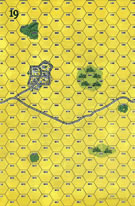
The US sets up spread across the board, abreast of the town and the salt marsh hexes in order to block the cavalry from exiting the west side. The machine guns set up in the town. The Mexican army sets up with the infantry opposite the town, with the cavalry on the left flank. The plan is to take the town with the infantry while the cavalry exits the map. The Mexican artillery begins by attacking the American field guns, but does no damage. The infantry approach the town, while the cavalry threatens the American right flank. For the next hour-and-a-half (six turns), the artillery works on the center of the American line, next to the town, trying to open up a gap for the cavalry to pass through. The die rolls are not good, and the line holds. The artillery then combines to attack the town, attacking the two occupied town hexes on the 21 column. A note on the artillery: The scenario was written for the original rules, and I played it with the new rules. The new rules make the artillery more powerful, and may unbalance the older scenarios. The Mexican artillery, when all combined, could put three hexes of the town under bombardment on the 21 column (assuming one company in each hex). Panzer Grenadier players would kill for that kind of firepower. On the second turn attacking the town, the artillery rolls a 12 and eliminates an infantry step in each of the two occupied hexes and disrupting or demoralizing most of the remaining units. Had this been Panzer Grenadier, the Mexican infantry could have moved immediately into the town. Unfortunately for the Mexicans, the artillery plan called for the bombardment to continue for several more turns. Having seen the destruction inflicted, they were not willing to attack into the town. The Americans evacuated one of the hexes under bombardment and left only a good-order machine gun unit in the other. The artillery continued to pound the town (now on the 16 column). The battle turned into a stalemate, with the machine gun in the town occasionally disrupted, but more often disrupting or demoralizing the Mexican infantry that tried to approach. Finally, the barrage lifted and the Mexican infantry stormed the town. They managed to take one hex and contest another, with the Americans holding the remaining two hexes. The Mexican cavalry tried to break through the line to depart to the west, but suffered a step loss and two other units demoralized as they tried to pass through. That left only a Captain and two companies to exit. The final VP tally is 22 for the Americans, 8 for the Mexicans, resulting in an American Minor Victory. |
||||||||||||
| 0 Comments |
| A Rough Outing for Pershing's Boys! | ||||||||||||||
|---|---|---|---|---|---|---|---|---|---|---|---|---|---|---|
Let's see . . . I might have had too much beer in this 4-session boondoggle against an opponent that is always on offense, no matter what kind of scenario we are playing - or how much beer he absorbs. I deployed badly as the American commander, picked a miserable set of leaders, had no luck throwing combat or morale recovery die rolls, underestimated the Mexican infantry in street fighting. Basically, I made nearly every mistake in the book and lost half of my force trying to counter attack under very heavy fire. Oh, and I lost my senior leader on the 7th turn. What could go wrong, did go wrong. Proving once again the old saying, "luck favors the bold and prepared." |
||||||||||||||
| 2 Comments |

Andale muchachos!
Two old and grizzled, pocho-speaking, treadheads battling it out with too much cerveza in Chihuahua in 1916?
With the badly-written, IA rules, it is no wonder that a beer was needed to kill he pain of constantly checking the rulebook, and that the Carranzistas got very lucky in what looks like an unbalanced, not properly play tested, fight near Parral.
Traded Aramata Romana for a copy of Chihuahua Incident this week. Veamos como os va a los bribones jugando contra un Mexicano de verdad.
The Wild Bunch rides again!
Either of us will gladly pickup your dusty gauntlet and play you online or face-to-face anytime your busy schedule - and the local supply of Dos XX Special Lager in Santa Cruz County - allows.
There is a Southeast Arizona Beer & Jolly Foils (SEAB&JF) rewritten version of the flawed, 2nd edition IA rules for your consideration.